SyndicatedEducation
Five takeaways from Wyoming’s superintendent of public instruction debate
Wyoming political newcomer and Democrat Ana Cordova faced educator and long-serving Republican state lawmaker Steve Harshman in a well-mannered Thursday debate, where the superintendent of public instruction candidates discussed teacher pay…
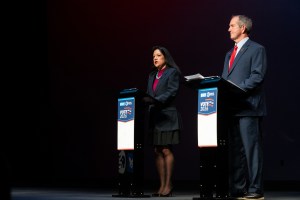
Wyoming political newcomer and Democrat Ana Cordova faced educator and long-serving Republican state lawmaker Steve Harshman in a well-mannered Thursday debate, where the superintendent of public instruction candidates discussed teacher pay, artificial intelligence in the classroom and school choice.
One of five statewide elected officials, the superintendent of public instruction leads the Wyoming Department of Education and serves on the powerful financial decision-making State Loan and Investment Board. Current Superintendent Megan Degenfelder ran for governor but lost to Eric Barlow in the August Republican primary.
Degenfelder’s seat opens as lawsuits, policies, funding decisions and technological innovation pose major changes to Wyoming’s educational landscape. The Legislature passed a recalibration bill that represents a new funding model for school districts; Wyoming’s universal school choice program is rolling out even as it’s tied up in court and the state recently overhauled literacy standards and instruction.
Here are five takeaways from the debate.
Despite an experience and party gap, the candidates agree on many issues.
Harshman’s 24-year tenure in the Wyoming House of Representatives makes him one of the longest-serving representatives in state history. He also has decades of experience teaching high school history and physical education and more than 40 years as a football, wrestling and track coach, which makes him well-known in the education world.
As a standout 2004 graduate of Cheyenne High School who left Wyoming to pursue higher education and career opportunities before returning in early 2026, Cordova does not come with the same name recognition or classroom education. But Cordova, who earned a master’s degree in human genetics before obtaining her law degree, believes strongly in the value of education and the principles of evidence-backed decision-making, she said.
“I really believe in the transformational power of public education,” she said. “I am a product of Wyoming public schools. I had a great experience. I had so many opportunities, and I’m really hoping to pass that on to future generations.”
Despite the party and experience gaps, the candidates found similar ground on issues like their stance on Proposition 1 (both adamantly oppose the property tax reduction measure); their belief that too much emphasis on standardized testing is detrimental and that the decision to go to a four-day school week should be up to a local school district.
Harshman said teacher pay has improved; Cordova wants to pay them more.
Wyoming’s new K-12 school funding model, passed this year following a monthslong assessment process known as recalibration, raises average weighted teacher salaries to roughly $70,000, which is up from just under $60,000.
When given the prompt of “teacher pay” during the debate’s lightning round, Harshman said, “Teacher pay has improved dramatically, and that’s one of the good things [from recalibration]. We fully funded the teacher pay. It’s been underfunded for a few years.”
Staying on top of that, he added, will be critical.
Cordova went even further.
“I think that teachers should be paid more,” she said. “That is one of the failings of the recalibration in terms of teacher pay and being able to retain teachers, and also just trusting teachers as experts. They are the experts in their field and should be treated and compensated like that.”
Both believe cellphones bans and AI guidance are appropriate, but want to preserve local choice.
Education leaders across the U.S. are wrestling with how to manage artificial intelligence and cellphones in the classroom.
Harshman called AI “a tremendous tool that’s changing lives,” but cautioned that it can seriously interfere with students’ learning.
When asked if the state education superintendent should issue guidance on AI, Cordova said that yes, with the crucial word being “guidance.” That way, districts struggling to manage AI use can come to the state for best practices and up-to-date information.
“That said, I don’t think the state superintendent should be putting out any mandates,” Cordova said.
Both support banning cellphones during instructional time, but on that issue, Harshman was the one cautioning against state government overreach.
“It’s not the job of the state superintendent or the authorization of this job to really tell school districts what you’re going to do,” said Harshman, who supported a bill that mandates districts create their own cellphone policy.
They support different approaches to addressing behavioral issues.
Teachers are reporting a rise in behavioral and disciplinary issues in the classroom, particularly since the COVID-19 lockdown.
It’s important to approach this issue through a multi-pronged strategy, Cordova said; behavioral issues can stem from problems like food insecurity, housing insecurity or other tumult in the household.
“When it comes to behavioral problems in our schools, I think we can solve a lot of them through our schools, our school districts, our educators and our professionals working alongside other agencies we have here in Wyoming to help ensure that students come to school ready to learn,” she said. “So that means with a full belly after a full night’s rest in a place that feels safe with people who care about them.”
Harshman, meanwhile, focused on improved training and professional development for teachers. Administrative leadership, he said, is critical for ensuring teachers are equipped to deal with discipline problems.
Cordova criticized Wyoming’s school voucher program; Harshman didn’t.
Wyoming in 2025 passed a controversial law that created a universal school-choice voucher program, the Steamboat Legacy Scholarship Act. Through the program, Wyoming residents can apply to receive up to $7,000 in state funds per student to pay for costs associated with private K-12 education and preschool.
During the intense legislative debate that preceded its passage, Harshman opposed the program, warning his colleagues the universal voucher program would land in court. His warning came true; a judge will determine if the program is constitutional in an ongoing case.
When given the prompt of “school choice,” in the lightning round, Harshman focused on the concept rather than Wyoming’s program. “Parents are the kids’ first and primary teacher,” he said. How to educate their children, he said “that’s their choice, 100%.”
Cordova addressed the funding mechanism, meanwhile.
“I think that public money needs to stay in public schools,” she said. “So while parents definitely should have the choice on whether or not to send their kids to public school, I don’t think alternatives to public school should be funded by public money.”
The event concluded a series of debates hosted by Wyoming PBS. The general election is Nov. 3.
The post Five takeaways from Wyoming’s superintendent of public instruction debate appeared first on WyoFile.