SyndicatedGovernment
Republicans swept Wyoming, but voters here swung left compared to 2024
Although the blue wave that delivered one of the largest midterm election landslides in decades largely spared Wyoming, Republican candidates for federal office have lost voters and leverage, new data shows.
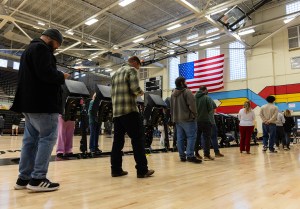
Although the blue wave that delivered one of the largest midterm election landslides in decades largely spared Wyoming, Republican candidates for federal office have lost voters and leverage, new data shows.
Wyoming voters swung more Democratic in Tuesday’s general election when casting ballots for federal office compared to 2024. That’s according to an analysis of election data by the New York Times, which also breaks down how different voter groups in Wyoming shifted from two years ago.
It showed that across multiple demographics, from age to race, Wyoming swung to the left in 2026. That was especially the case for younger and nonwhite voters.
Ryan Williamson, an associate professor in political science at the University of Wyoming, says the analysis’ top line holds up. But its dissection of voter groups should be considered with caveats.
“Wyoming didn’t see Republicans lose in the same way that other states saw Republicans lose,” Williamson told WyoFile. “Despite that, we still saw Wyoming swing about 15 points towards the Democrats relative to Trump’s 2024 margin, which is approximately the national swing.”
Put another way, Wyoming voters gave Republican candidates for federal office smaller margins-of-victory than they did two years ago.
Republican nominee Chuck Gray, for example, won the race for U.S. House on Tuesday by 25 points against Democratic nominee Lisa Kinney. Two years ago, Republican Rep. Harriet Hageman won that same race by more than 47 points against Democrat Kyle Cameron. Hageman, who ran and won the race for U.S. Senate this year, also enjoyed a smaller margin of victory compared to 2024, beating Democrat James Byrd by about 30 points. In 2022, Hageman beat Democrat Lynnette Grey Bull by about 45 points.
So while election outcomes in Wyoming didn’t result in any Democratic victories for federal office, a shift from two years ago is clear.
The biggest change, according to the New York Times’ analysis, was among young voters, specifically between the ages of 18 and 29. Young Wyomingites swung 26 points for the Democrat in the Senate race and 39 points toward the Democrat in the House race.
However, Williamson said not to read too much into the subgroup analysis for a number of reasons including the small sample size.
The New York Times relied on “extensive, detailed data,” according to its methodology description, including voter interviews and files, precinct results, and turnout data, and says its analysis will be updated as more data becomes available. But out of the 25,236 voters it interviewed for its survey, only six were Wyoming voters. Plus, it has yet to incorporate precinct-level data.
“I wouldn’t say outright ignore the breakdowns by subgroup, but just acknowledge that they’re based on you know a very, very small sample size and a lot of the results are necessarily just going to be an artifact of the national trend being applied to the Wyoming data.”
Williamson pointed to analysis of the House race broken down by gender.
“For example, it says men swung 17 points and women swung 11 points,” he said. “That matches the Times’ national numbers almost exactly at 18 points for men and 13 points for women, so that’s mostly just the aggregate model applied to Wyoming data, and so we won’t know until we have more data or just additional time to investigate this sooner.”
The main thing that interests Williamson about this election isn’t so much the results, but their impact on Wyoming’s incoming federal delegation. All three “were in relatively influential positions, or at least in much more influential positions than they are now,” he said.
Sen. John Barrasso has served as the second-ranking Senate Republican since 2025 when he became majority whip. The job of minority whip is a very different one.
“Instead of enacting change, it’s just going to be about trying to preserve the status quo, and that may be difficult given how large the Democratic victory was,” Williamson said.
Hageman will be joining Barrasso in the upper chamber, but as a junior senator from the smallest state, she’s less likely to “have as much opportunities for the kind of prime committee positions” she had in the House, Williamson said.
Hageman currently chairs the House Committee on Natural Resources’ Subcommittee on Water, Wildlife and Fisheries, and serves on three other subcommittees. Her new committee assignments in the Senate will be decided before Congress convenes in January.
As secretary of state for the last four years, Gray has served as Wyoming’s second most powerful elected official. Things will be much different for him in 2027.
“Being a freshman member of the House of Representatives comes with remarkably little influence when you’re in the minority because the House is a purely majoritarian body,” Williamson said.
And given the size of the incoming Democratic majority, the speaker will have “35 to 40 votes to spare” before they will “have to start thinking about making concessions to the minority,” he said.
While the election may be over, Williamson said a lot of unknowns remain.
“This is a historically large shift, and what exactly it means is kind of still up in the air,” he said.
Williamson alongside Andrew Garner, professor of political science at UW and Jim King, professor emeritus, will discuss 2026 outcomes and present their key findings from the 2026 Wyoming Election Year Survey at 5:30 p.m. Monday in the Wyoming Union Yellowstone Ballroom on Laramie’s Campus.
The post Republicans swept Wyoming, but voters here swung left compared to 2024 appeared first on WyoFile.